Our own audit
willaicite ran on its own site. Below: the baseline report, the fixes it prescribed, and the result. Every number comes from logged runs on July 17, 2026.
Where did the site start?
The verdict line read “Needs work: real gaps are limiting how AI engines retrieve and cite this site.” The page was technically clean and completely uncitable: readable by every crawler, with nothing an answer engine could attribute, date, or quote.
| dimension | baseline | after |
|---|---|---|
| AI crawler access | 100 | 100 |
| Renderability | 100 | 100 |
| Structured data | 0 | 100 |
| Answer-readiness | 45 | 100 |
| Evidence density | 28 | 100 |
| Freshness | 30 | 100 |
| Entity & E-E-A-T | 20 | 100 |
| Overall | 51 | 100 |
What did the audit flag?
- Structured data, 0 to 100. The report said, word-for-word: “no JSON-LD blocks found on the audited pages”. Fixed with one schema graph: Organization, Person, WebSite, TechArticle with author and dates, FAQPage, BreadcrumbList.
- Answer-readiness, 45 to 100. No definitional opening, one question-shaped heading, no FAQ. The page now opens with a sentence an engine can lift whole, and the FAQ renders from the same array as its FAQPage markup, so the two cannot disagree.
- Evidence density, 28 to 100. The baseline had zero statistics and one outbound link; the fix-first list read, word-for-word: “Add concrete statistics with units (%, $, counts) to the main content”. The original GEO study measured lifts of 24.9 to 27.8 percent from cited sources, statistics and quotations.
- Freshness, 30 to 100. No dates anywhere, and the audit rewards a machine-readable date signal from the last 90 days. Dates went into the schema, the meta tags, and the sitemap.
- Entity & E-E-A-T, 20 to 100. No author, about page, contact route, favicon, or Open Graph metadata. All added, none of it decorative.
What happened when the model got stricter?
Then the scoring model was recalibrated to the 2025–2026 replication research: a new eighth dimension, topical focus & metadata, weighs how clearly a page states one topic. Under it, this site re-scored 97/100: the new dimension flagged the slogan-only H1 and a 238-character meta description. The findings held, so we fixed them: the homepage now leads with the question it answers, and the description fits the band. We hold this site to the same bar as any other, and it does not get a pass.
What does it score now?
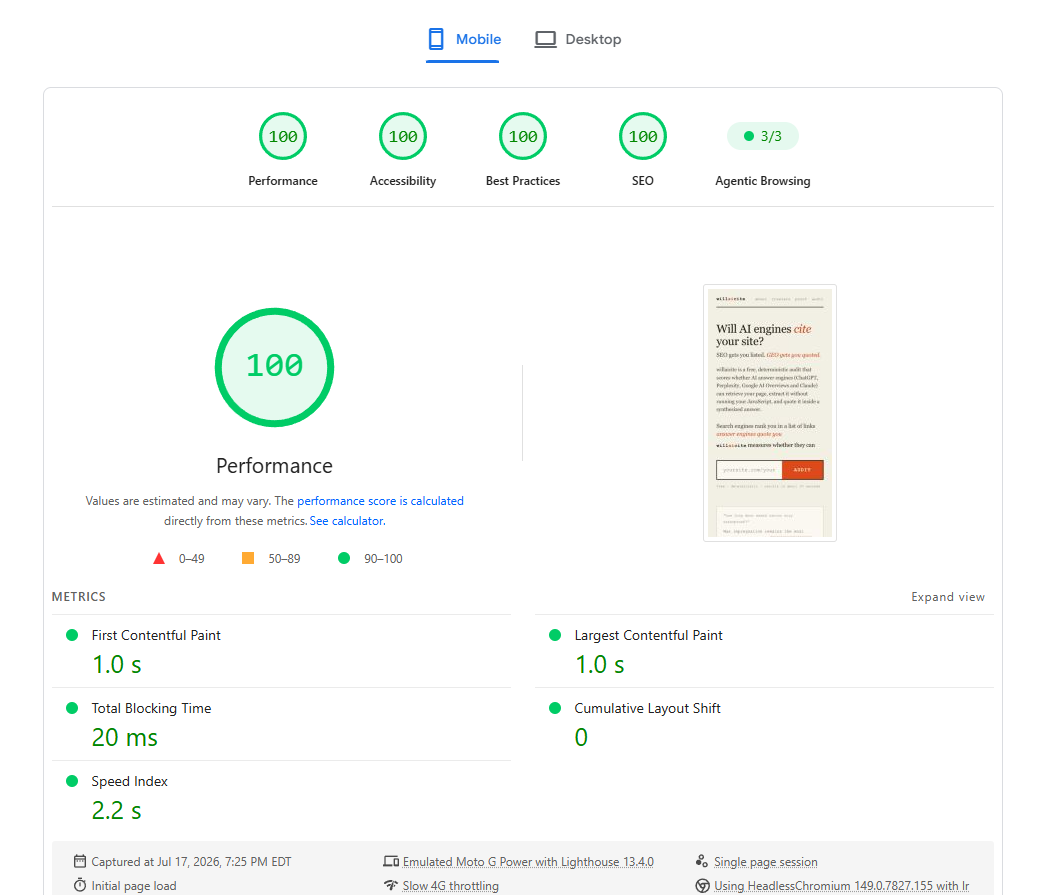
The after column above is the v1.2 re-run, and its fix-first list is empty. Independent measures agree: Lighthouse scores the page 100 for performance, accessibility, best practices, and SEO, and PageSpeed Insights measured first paint at 1.0 seconds with 20 ms of blocking time and zero layout shift (mobile, July 17, 2026). Here is the capture:
FAQ
Where does each point come from?
Every point is tied to a page property anyone can inspect: the JSON-LD is in the source, the citations resolve, the dates match the git history, and the FAQ you are reading renders from the same data as its schema markup. The audit is deterministic, so re-running it reproduces the same evidence lines. Running the tool on ourselves also caught a scoring bug (percent-sign statistics could never be counted), which we fixed and shipped the same day.
Can I reproduce these numbers?
Yes. Run the audit on willaicite.com and you get the same score from the same evidence; that is what deterministic means here. The independent measures are reproducible too: Lighthouse scores this page 100 in all four categories, and you can paste any page of this site into Google’s Rich Results Test or the Schema.org validator to check the structured data yourself.
Why does this matter for my site?
This site went from 51 to 100 using the same loop the tool gives you: audit, fix what the report flags in priority order, re-run until clean. The fix-first list is sorted by impact per effort, so a score that looks expensive usually comes down to a handful of small, concrete changes.
Verify it yourself
- Re-run the audit: willaicite.com/audit?url=willaicite.com
- Google Rich Results Test: paste any page of this site
- Schema.org markup validator: check the JSON-LD graph
- PageSpeed Insights: performance and Core Web Vitals
- Evidence basis for the scoring model: Aggarwal et al., GEO, KDD 2024, plus the 2025–2026 replications listed on the about page